
business support, one step to solution

When ordering custom precision parts, engineers and procurement professionals often face a critical question: what is the difference between CNC turning and milling? And which process is right for my part?
Understanding the core differences between these two machining methods not only helps optimize product design but also reduces manufacturing costs and shortens lead times. This article explains the distinction clearly and shows how JRS's precision machining capabilities can help you make the right choice.
CNC Turning: Rotating Workpiece – Ideal for Cylindrical Parts
In CNC turning, the workpiece rotates while the cutting tool remains stationary. This process is ideal for manufacturing round or cylindrical parts such as shafts, bushings, fittings, and threaded rods. Turning can efficiently machine outer diameters, inner holes, end faces, and threads.
JRS is equipped with high-precision CNC lathes and Swiss-type automatic lathes, capable of machining parts up to 500mm in diameter and 1000mm in length, with tolerances as tight as ±0.005mm. We work with a wide range of materials including stainless steel, aluminum, copper, titanium alloy, and engineering plastics.
CNC Milling: Rotating Tool – Ideal for Prismatic & Complex Shapes
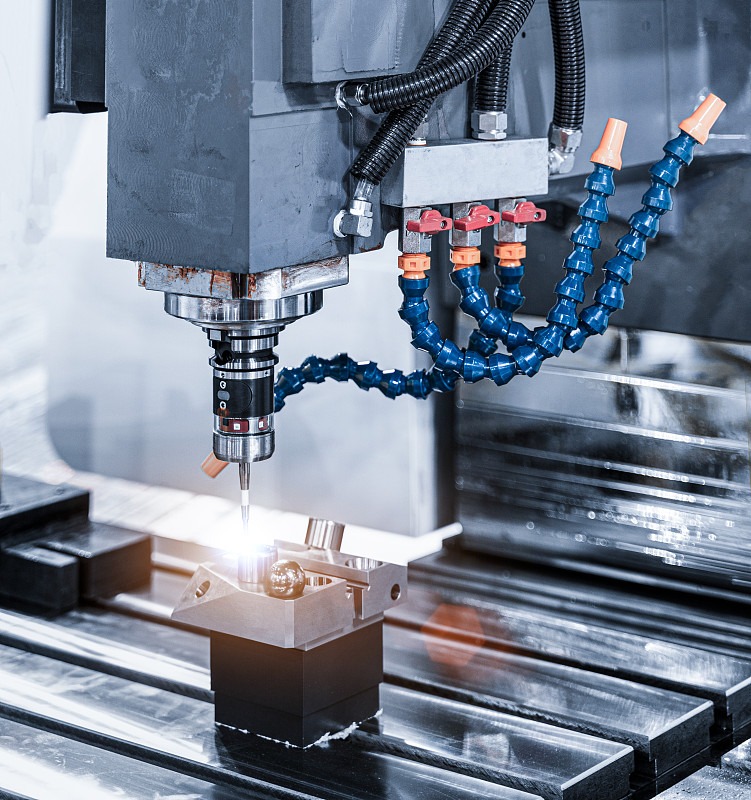
In CNC milling, the cutting tool rotates while the workpiece remains stationary. Milling is suitable for square, irregularly shaped parts, or components with slots, holes, contoured surfaces, or complex geometric features – for example, heat sink housings, sensor brackets, and mold cavities.
JRS offers 3-axis, 4-axis, and 5-axis simultaneous milling services. Multi-face machining can be completed in a single setup, reducing process steps and cumulative errors – particularly well-suited for small to medium batch production of complex parts.
How to Choose Between CNC Turning and Milling – A Simple Rule
A quick way to distinguish between CNC turning and milling is to look at the overall shape of your part:
If your part is cylindrical or round in shape – prioritize turning.
If your part is square, irregular, or has complex holes, slots, or curved surfaces – prioritize milling.
If your part has both cylindrical and irregular features – mill-turn composite machining is the best choice, completing all operations in one setup for higher accuracy and better efficiency.
JRS Mill-Turn Composite Machining – One-Stop Solution for Complex Parts
JRS operates advanced mill-turn machining centers capable of completing turning, milling, drilling, tapping, and boring – all in one machine and one setup. This is particularly suitable for parts with complex shapes, high concentricity requirements, and those needing minimal refixturing – such as valve bodies, precision bushings, and medical device components.
Why Choose JRS?
As a professional CNC precision machining manufacturer, JRS not only helps you understand the difference between CNC turning and milling but also provides one-stop services including drawing review, process design, prototyping, and mass production. With an ISO9001 certified quality system, strict inspection processes, and an on-time delivery rate above 98%, we ensure every custom order is reliable and worry-free.
Need help choosing the best process for your parts? Send us your drawings or samples. The JRS team will provide professional process recommendations and a quote within 24 hours.